
Resources
Evaluating Skincare Formulations With Human-Relevant Skin Models and LC-MS
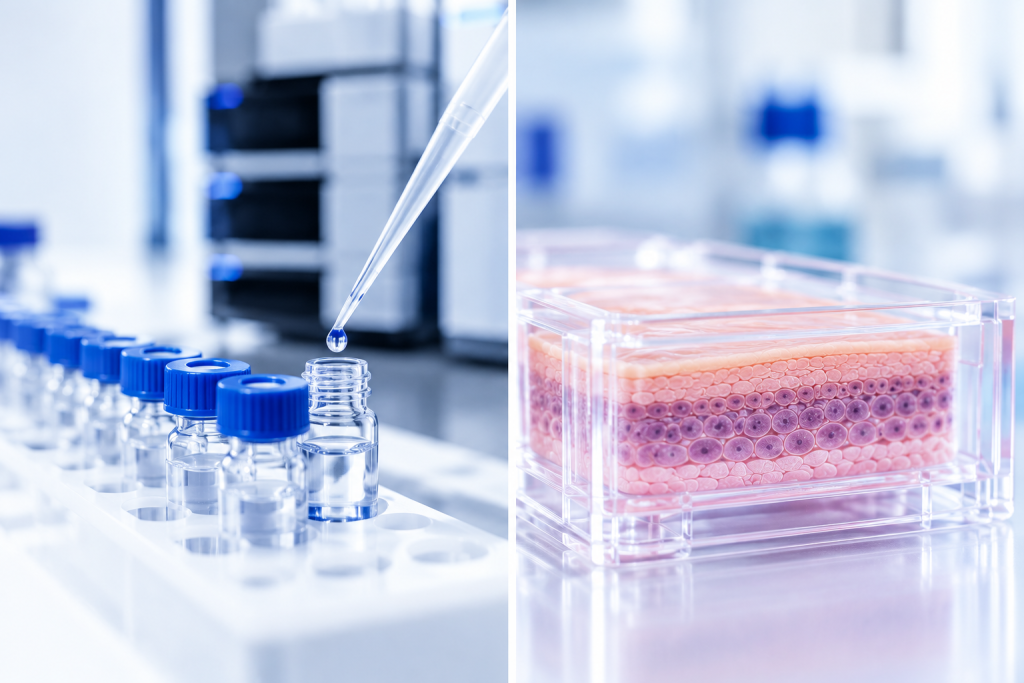
Evaluating skincare formulations requires more than measuring a functional response. For cosmetic scientists and formulation researchers, characterizing the molecular changes associated with that response can provide additional context for comparing ingredients and investigating formulation performance. Combining human-relevant skin models with liquid chromatography–mass spectrometry (LC-MS) analysis allows researchers to examine functional endpoints alongside molecular profiles, generating data to support further investigation.
Why Functional Testing May Not Explain Formulation Differences
Skin care product testing can assess functional endpoints such as skin barrier function and irritation-related responses under controlled experimental conditions. These measurements help researchers characterize how skin responds to specific ingredients, concentrations, or formulations.
However, functional measurements do not necessarily reveal the molecular changes associated with an observed response. Two formulations may produce different barrier-related outcomes without identifying the molecular differences associated with those results. Conversely, similar functional measurements do not establish that two formulations produce equivalent molecular responses.
For cosmetic R&D teams, this distinction raises important questions: Which molecular changes accompany a treatment-related response? Do different formulations produce distinguishable lipid or protein profiles? And which analytical approaches can help characterize those differences?
LC-MS can help investigate these questions by separating molecular components and measuring their mass-to-charge ratios. The resulting data can support the characterization of compounds in relevant biological samples, extending the investigation beyond functional endpoints.
How Human-Relevant Skin Models and LC-MS Work Together
Human-relevant skin models provide controlled experimental systems for evaluating biological responses to skincare ingredients and formulations. Functional testing establishes measurable outcomes, while LC-MS can characterize molecular features in relevant samples collected during the study.
Researchers can use functional findings to identify questions for molecular investigation, then compare analytical results across appropriate treatment groups or experimental conditions. The suitability of this approach depends on the biological question, model, sample type, and analytical workflow.
Lipidomics: Characterizing Lipid Changes Associated With Skin Barrier Function
The skin barrier depends in part on the composition and organization of lipids within the stratum corneum. When researchers observe differences in barrier-related endpoints between formulations, LC-MS-based lipidomics can help characterize differences in the lipid species present in relevant samples.
Depending on the analytical workflow, researchers may compare lipid profiles across treatment groups to investigate differences in lipid composition and relative abundance. For example, if two formulations produce different barrier-related measurements, lipidomic analysis may reveal associated differences in the lipid species detected in the samples.
These findings can help researchers determine whether functional differences coincide with measurable changes in lipid profiles, generating hypotheses about the relationship between lipid composition and the observed response.
Proteomics: Investigating Protein-Level Responses to Formulations
LC-MS-based proteomics can help researchers characterize protein-level changes associated with ingredient exposure or formulation treatment. In a typical bottom-up proteomics workflow, proteins are digested into peptides, which are separated by liquid chromatography before mass spectrometry generates data used for peptide identification and protein inference. Depending on the method, the resulting data may also support relative protein quantification.
Comparing protein profiles across experimental conditions can help researchers identify proteins or patterns associated with a particular treatment response. These findings may provide additional context for interpreting functional observations and prioritizing targets for follow-up investigation.
Lipidomics and proteomics provide complementary information because they examine different molecular classes. The appropriate approach depends on the research objective, sample characteristics, and analytical methods available.
Interpreting Functional Results Alongside Molecular Data
Integrating functional measurements with molecular profiles can help researchers characterize treatment-associated differences more comprehensively. Functional endpoints establish the observed response, while LC-MS data can reveal molecular patterns that warrant further investigation.
Interpretation requires appropriate controls, relevant comparisons, and consideration of biological variability, sample handling, and analytical coverage. Molecular associations do not independently establish causation, confirm a mechanism of action, or demonstrate clinical efficacy. Instead, findings can support hypothesis generation, refine experimental questions, and guide subsequent studies.
Aligning Skin Models and LC-MS Methods With R&D Objectives
Selecting an appropriate testing strategy begins with defining the biological question. Model selection, treatment conditions, functional endpoints, sample collection, and analytical methods should be considered together to ensure that the resulting data address the intended research objective.
iFyber combines expertise in preclinical research, cellular and tissue models, and LC-MS analytical services to help researchers evaluate approaches for characterizing biological responses. By considering experimental models and molecular analysis together, iFyber can help research teams investigate functional observations at the molecular level and identify opportunities for additional study.
Discuss Your Skincare Formulation Research With iFyber
Human-relevant skin models and LC-MS analysis can help cosmetic scientists characterize functional responses alongside associated molecular changes. This integrated approach supports formulation comparisons, molecular profiling, and the development of focused follow-up research questions.
Contact iFyber to discuss ingredient or formulation research objectives and identify an experimental and analytical approach aligned with the biological questions the study needs to address.