Resources
Advancing Dental Material Biofilm Testing with High-Throughput In Vitro Assays
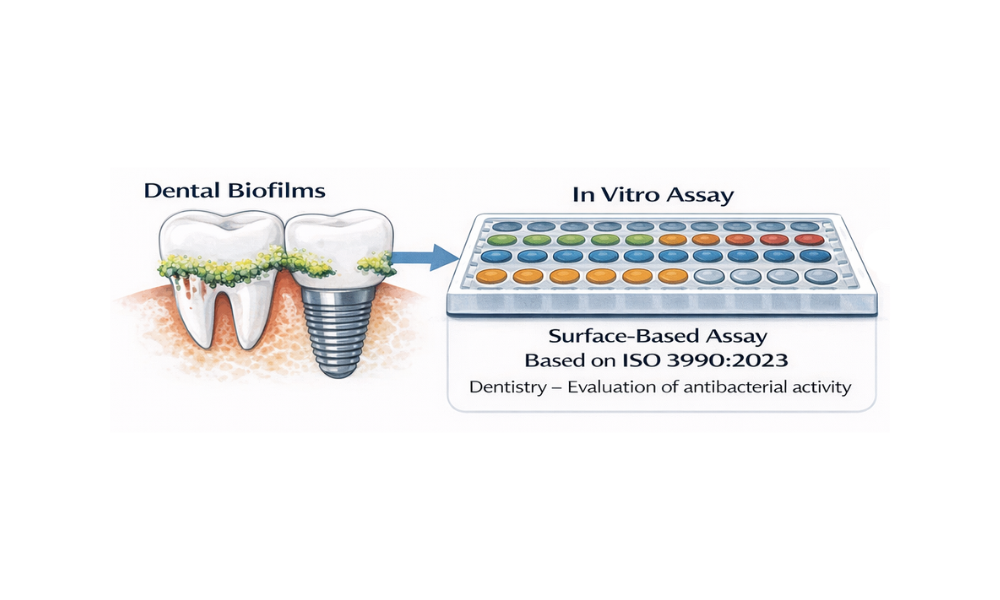
For teams developing dental and implant materials, biofilm performance is a defining factor in clinical success, regulatory acceptance, and product differentiation.
The challenge is not in understanding biofilms, but generating reliable, clinically relevant data that reflects how microbial communities interact with material surfaces under real-world conditions.
Traditional antimicrobial testing approaches often fall short in this context. To address this gap, high-throughput, surface-based in vitro assays aligned with ISO 3990:2023 enable quantitative evaluation of both antimicrobial activity and biofilm formation directly on material surfaces.
These in vitro diagnostic (IVD) assays are designed to produce reproducible, decision-ready data that supports formulation selection, performance benchmarking, and regulatory strategy.
Why Dental Biofilm Testing Matters for Material Performance and Patient Outcomes
In the oral environment, biofilm-associated bacteria present a more relevant and challenging evaluation target than planktonic systems, requiring testing approaches that reflect surface-driven microbial interactions.
Because biofilms are significantly more resistant than planktonic bacteria, traditional antimicrobial testing methods alone are not sufficient. Without biofilm-specific evaluation, material performance may be overestimated, increasing the risk of late-stage failure or underperformance in clinical use.
Effective evaluation of dental materials therefore requires biofilm-specific testing approaches capable of generating quantitative data under surface-driven conditions that reflect in-use performance.
The Role of In Vitro Models in Oral Biofilm Analysis
Modern oral biofilm analysis relies heavily on in vitro testing platforms. These systems provide controlled, reproducible environments that allow researchers to evaluate how dental materials interact with microbial communities.
Compared to clinical studies, in vitro assays offer several advantages:
- Faster turnaround times
- Lower costs
- High reproducibility
- Flexibility in experimental design
These benefits make IVD assay models a foundational tool in implant material testing and early-stage product development. They also generate quantitative data that can strengthen regulatory submissions and guide material optimization.
High-Throughput, Surface-Based Biofilm Testing for Dental Materials
To generate more predictive performance data, iFyber developed a high-throughput, surface-based assay specifically designed for dental material biofilm testing.
Unlike conventional approaches that focus on planktonic activity alone, this platform evaluates bacterial attachment and biofilm formation directly on material surfaces, providing a more relevant assessment of in-use performance.
Based on ISO 3990:2023, the in vitro assay enables standardized, quantitative comparison across microorganisms, materials, formulations, and coatings.
Key Capabilities of the Assay
Surface-Driven Evaluation
Direct measurement of bacterial attachment and early biofilm formation on material surfaces, reflecting clinically relevant interactions.
Dual-Mode Assessment in a Single Experiment
Simultaneous evaluation of antimicrobial activity and biofilm inhibition in a single experiment reduces study complexity while increasing data density.
Quantitative Output for Comparative Analysis
CFU-based enumeration enables precise measurement of biofilm burden, supporting side-by-side material comparisons and performance thresholds.
Surface and Leachable Effect Characterization
Enables differentiation between contact-based and leachable antimicrobial effects, providing a more complete and application-relevant understanding of material performance.
Configurable to Study Objectives and Regulatory Pathways
Experimental design can be tailored to material properties, microbial species, and intended use, ensuring alignment with development and submission strategies.
Case Study: Quantitative Comparison of Anti-Biofilm Performance
A controlled comparative study was conducted to evaluate three novel dental materials against Streptococcus mutans, using hydroxyapatite as a clinically relevant control surface.
Following standardized inoculation and incubation, surface-associated bacteria were quantified via CFU enumeration to measure biofilm burden.
Results
- All materials reduced biofilm formation relative to control
- Two formulations achieved >2-log reduction (meeting ISO performance criteria)
- One formulation achieved 1.75-log reduction
These results demonstrate how surface-based biofilm testing can generate quantitative performance thresholds to support material selection, optimization, and differentiation.
Integrating Biofilm Testing into a Broader Preclinical Dental Material Testing Strategy
While surface-based biofilm assays provide critical insight into material performance, they are most effective when integrated into a broader antimicrobial testing strategy.
Complementary methods may include:
- Minimum Inhibitory Concentration (MIC)
- Minimum Bactericidal Concentration (MBC)
- Minimum Biofilm Eradication Concentration (MBEC)
- Time-kill kinetics
- Barrier and penetration testing
Together, these approaches enable evaluation of both planktonic and biofilm-associated activity, providing a more complete and application-relevant understanding of material behavior.
For dental and implant material developers, the objective is not simply to demonstrate antimicrobial activity, but to generate quantitative data that reflects performance under surface-driven biofilm conditions.
By integrating high-throughput, surface-based assays with complementary methods, teams can:
- Accelerate iteration across material candidates
- Establish clear performance benchmarks
- Align data generation with regulatory expectations
- Reduce uncertainty in later-stage validation
This integrated approach enables a shift from exploratory testing to data-driven development decisions, improving both speed and confidence in material selection.
To evaluate how your material performs against biofilm formation in human-relevant models, connect with the iFyber scientific team and start a program discussion.